
From the Steam Age to AI: 1834 British Sixpence Investigation Informs IA STUDIO Research Framework
Independent physical measurements remained the primary empirical constraint, while final responsibility for interpretation remained human.
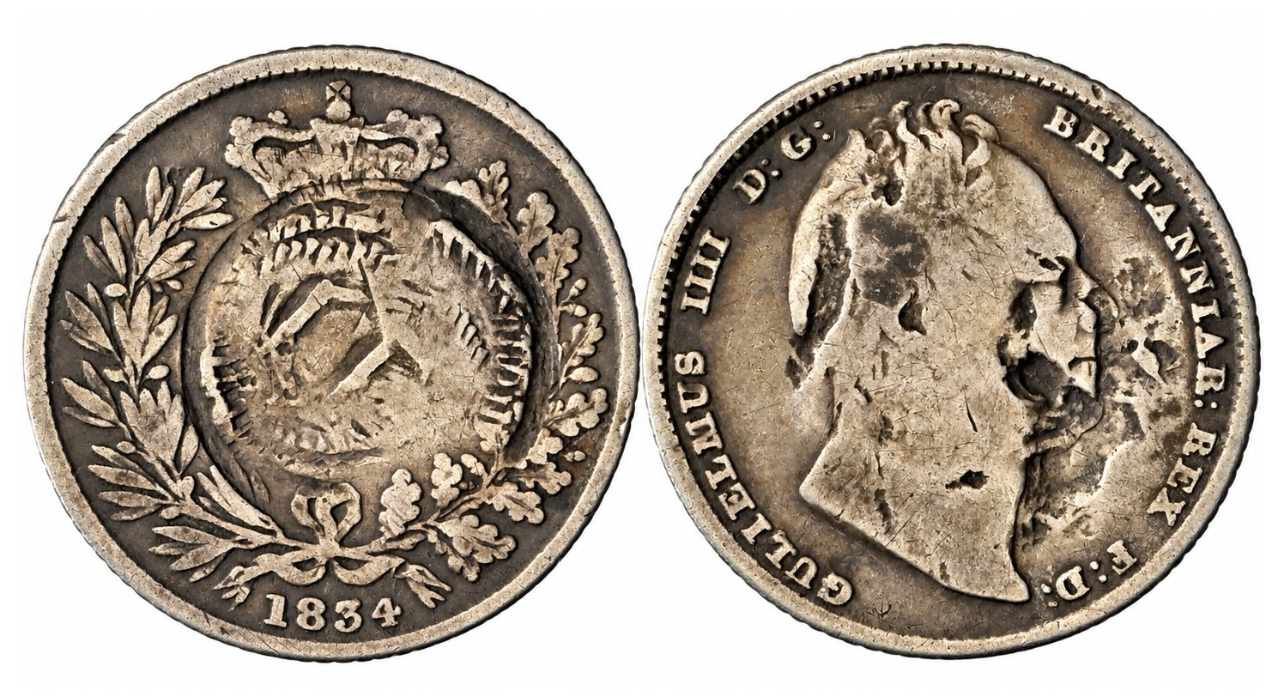
UNITED KINGDOM, 6 October 2026 — A severely deformed British silver sixpence struck in 1834 has become the founding documented case for a research methodology examining how AI-assisted reasoning can be used without being confused with empirical evidence.
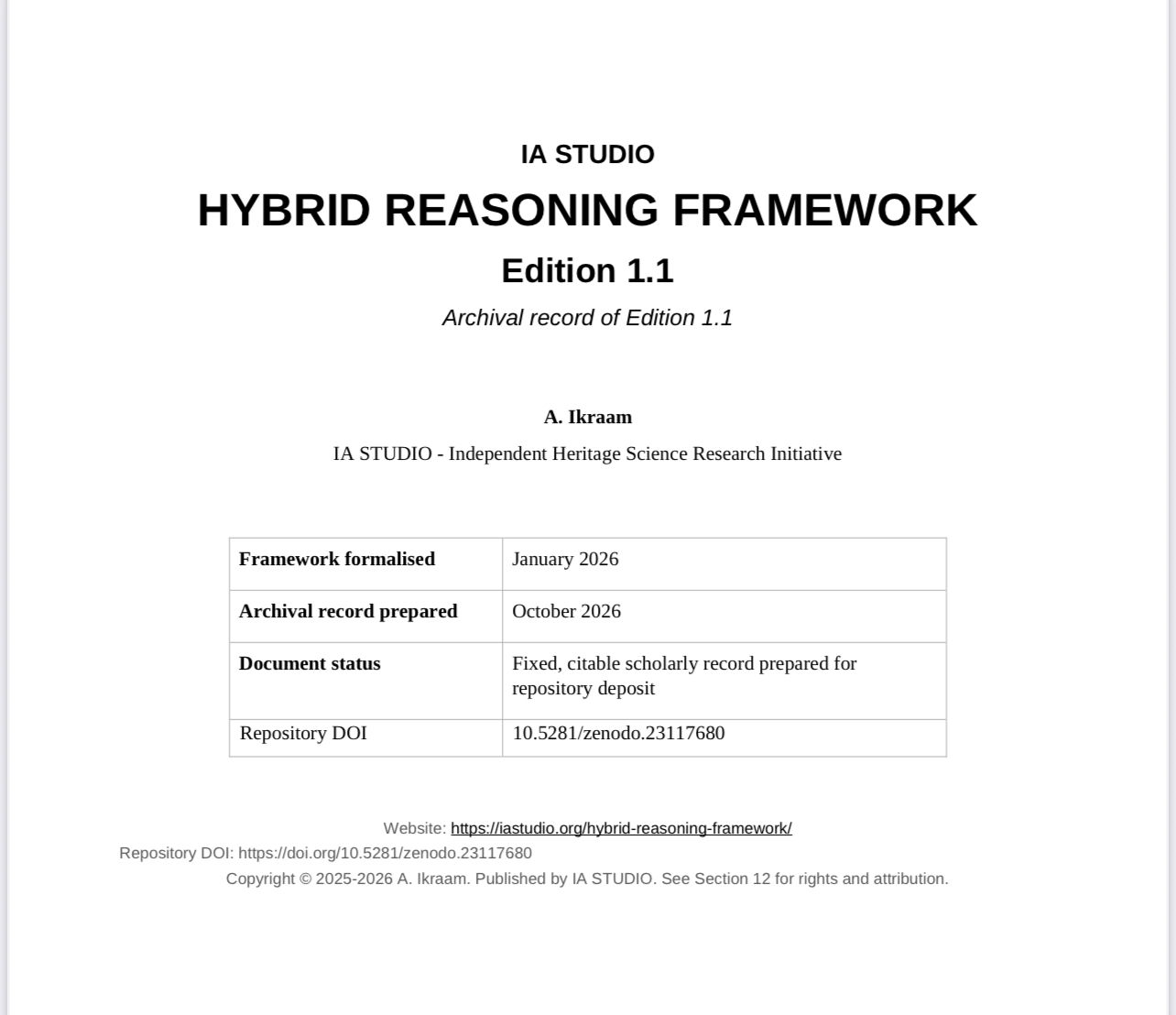
IA STUDIO has deposited a fixed archival record of the IA STUDIO Hybrid Reasoning Framework — Edition 1.1 on Zenodo, following publication of Project 001 in the peer-reviewed journal npj Heritage Science.
Project 001 investigated an unusually deformed William IV sixpence found in a mixed coin album acquired at a Greater Manchester car-boot sale. Early examination produced competing explanations for the specimen’s condition, including post-mint damage, prompting a move from visual interpretation to independent physical measurement.
IA STUDIO subsequently commissioned SEM–EDX analysis from the Experimental Techniques Centre at Brunel University London and optical surface profilometry through Oxford Materials Characterisation Service, Department of Materials, University of Oxford.
Those analytical services produced physical measurements that became the principal empirical constraint on interpretation. Interpretation of the resulting datasets remained the responsibility of the author; the analytical facilities were not co-authors and no institutional endorsement of the interpretation is implied.
The completed investigation was published in npj Heritage Science on 24 September 2026.
The peer-reviewed study reports that the combined physical evidence favours interpretation of the specimen as a severe mint-stage striking anomaly, rather than ordinary wear, corrosion or a single unconstrained later impact. The surviving evidence does not permit a completely unique reconstruction of the mechanical sequence, and later constrained compression cannot be absolutely excluded.
Alongside imaging, comparative research and laboratory analysis, human-supervised AI-assisted reasoning was used at different stages of Project 001, including before independent laboratory testing.
Computational tools helped organise observations, compare competing explanations, identify assumptions and develop working hypotheses. After laboratory testing, they were also used to assist comparison, organisation and research communication.
AI did not generate the SEM–EDX measurements, perform the optical profilometry, conduct peer review or determine the published scientific conclusion.
“For me, the framework is less about proving that AI was right and more about creating a process in which AI can be wrong, challenged and corrected while still remaining useful,” said A. Ikraam, founder of IA STUDIO. “Independent physical measurements remained the primary empirical constraint, while final responsibility for interpretation remained human.”
The methodological lessons emerging during Project 001 informed the IA STUDIO Hybrid Reasoning Framework, which was formalised as Edition 1.1 in January 2026 while the investigation was continuing.
The framework distinguishes four roles within an AI-assisted research process: empirical measurement, documentary evidence, computational interpretive support and final human interpretation.
It is deliberately model-agnostic, rather than dependent on any particular AI provider or model. Computational outputs are treated as provisional interpretive support and do not receive evidential priority over independently produced physical measurements where relevant measurements are available.
Following publication of the completed Project 001 study, a fixed archival record of Edition 1.1 was deposited on Zenodo on 3 October 2026, creating a stable and citable record of the methodology.
Project 001 serves as the framework’s founding documented case. IA STUDIO does not claim that Edition 1.1 has itself undergone separate peer-reviewed methodological validation. Future investigations are intended to evaluate its applicability, limitations and transferability across additional cases.
Also on 3 October, Springer Nature Research Communities published a Behind the Paper article by Ikraam describing the progression of Project 001 from pre-laboratory uncertainty and competing hypotheses to independently produced physical measurement and an evidence-constrained interpretation.
The project connects two very different technological eras: a coin produced during the early mechanised minting age of the 1830s, and contemporary AI-assisted research methods designed to remain accountable to physical evidence.
Primary sources
Peer-reviewed Project 001 study — npj Heritage Science
https://doi.org/10.1038/s40494-026-02901-0
IA STUDIO Hybrid Reasoning Framework — Edition 1.1: Archival Record
https://doi.org/10.5281/zenodo.23117680
Springer Nature Research Communities — Behind the Paper
https://go.nature.com/4yv7Up2
About IA STUDIO
IA STUDIO is an independent heritage science research initiative founded by A. Ikraam. Its work combines scientific examination, digital documentation, contextual research and human-supervised computational methods while maintaining explicit distinctions between measured evidence, interpretive assistance and final human judgement.
Project 001 is the initiative’s founding documented investigation.
Press release distributed by Pressat on behalf of IA STUDIO, on Tuesday 6 October, 2026. For more information subscribe and follow https://pressat.co.uk/
Artificial Intelligence AI-Assisted Research Heritage Science Research Methodology Human-AI Collaboration IA STUDIO Hybrid Reasoning Framework Computing & Telecoms Leisure & Hobbies Manufacturing, Engineering & Energy
Published By

[email protected]
https://iastudio.org/
A. Ikraam
Founder, IA STUDIO
[email protected]
https://iastudio.org
Visit Newsroom



You just read:
From the Steam Age to AI: 1834 British Sixpence Investigation Informs IA STUDIO Research Framework
News from this source: