
Drinking More Than You Want To? New Book Explores What Really Helps People Drink Less or Stop
Women, midlife and alcohol behind closed doors
Glasgow author James McInally says problem drinking can remain remarkably well hidden behind careers, families and otherwise ordinary lives — and people should not have to call themselves “alcoholic” or hit rock bottom before deciding to change, whether it's cut down or stop.
GLASGOW, SCOTLAND — Around one in five adults in England drinks at increasing or higher-risk levels, according to the latest Health Survey for England, while one in five adults in Scotland drinks at hazardous or harmful levels.
Among Scots aged 55 to 64, that figure rises to 28%. Yet problem drinking does not always look like the stereotype.
There may be no lost job, no public crisis and no obvious outward sign that alcohol is becoming a problem.
Instead, it can be the bottle hidden at the back of a cupboard. The wine poured before a partner gets home. The empties disposed of separately. The amount drunk quietly understated when somebody asks. And few people whi lives perfectly normal lives but drink too much, are less likely to reach out for help to a doctor or other professional due to stigma.
Or it can be much less obvious: drinking most evenings despite repeatedly deciding not to, topping up a glass almost automatically, worrying about how much was consumed the night before, or waking in the morning determined that tonight will be different.
From the outside, life can look completely normal. Inside, a much more uncomfortable question can be developing: Why am I drinking more than I actually want to?
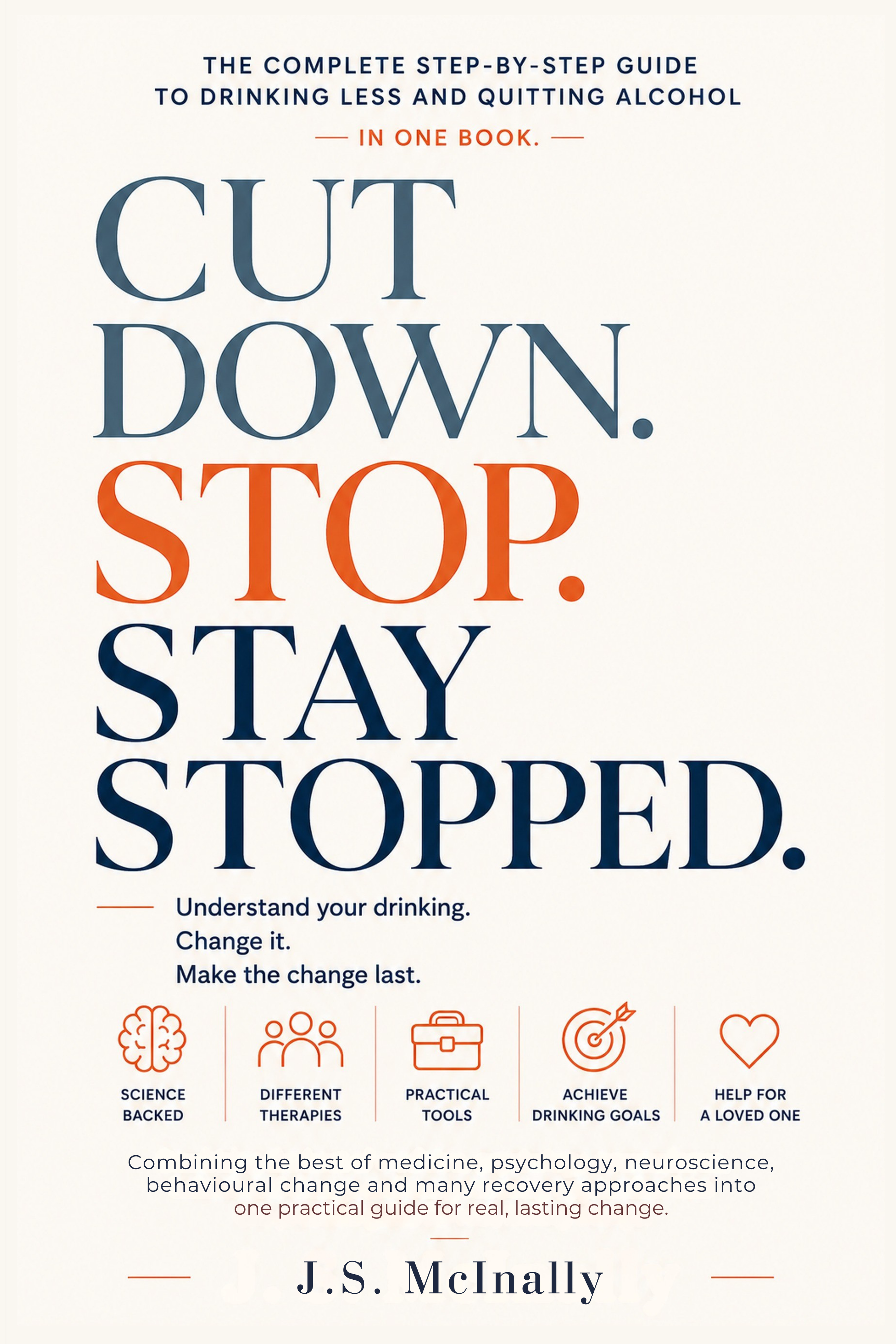
That question is at the heart of Alcohol: Cut Down. Stop. Stay Stopped., a new book by Glasgow author and alcohol recovery professional James McInally.
McInally believes conversations about alcohol too often gravitate towards the extremes: either someone's drinking is regarded as relatively normal, or alcohol problems are imagined in terms of severe dependence, “alcoholism”, rehab and rock bottom.
But alcohol problems do not suddenly begin when someone's life falls apart.
“Some people can be functioning extremely well in almost every area of their life while becoming increasingly worried about their drinking,” says McInally.
“They may have a career, a family, a home and an active social life. Nobody looking at them would necessarily think alcohol was a problem. Sometimes even the people closest to them don't know how much they're actually drinking.
“But they know. They know because they've started making rules about alcohol and breaking them. They know because they're hiding quantities, thinking about drinking more often, or waking up regretting it and promising themselves they'll do things differently.”
McInally argues that people do not need to adopt a particular label before taking concerns about their drinking seriously.
“You don't have to call yourself an alcoholic to acknowledge that alcohol is taking up more space in your life than you want it to.
“And you certainly don't have to wait until you've lost something important before you're allowed to change.”
Why do people drink when they genuinely don't want to?
Rather than treating excessive drinking simply as a failure of willpower, the book explores what can happen when alcohol becomes repeatedly associated with reward, relaxation, relief and routine.
The book examines dopamine and reward learning, GABA and glutamate, cravings, anxiety, sleep, stress, habits, cognitive distortions and the learned associations that can make drinking increasingly automatic.
It also examines the important shift that can occur when drinking becomes less about pleasure and increasingly about relief.
For some people, alcohol gradually becomes a way of switching off after work, quietening anxiety, falling asleep, escaping uncomfortable thoughts or simply changing how they feel.
Understanding those mechanisms, McInally argues, can help explain one of the most frustrating experiences reported by people trying to change their drinking.
“Someone can genuinely mean it when they wake up and say they aren't going to drink that evening — and then find themselves pouring a drink at six o'clock.
“Understanding why that happens doesn't remove personal responsibility. It gives us something much more useful: an opportunity to understand what's driving the behaviour and change it.”
There isn't one approach
A central argument of the book is that there is no single approach to changing our relationship with alcohol that will be right for everybody.
Across more than 300 pages, McInally brings together medical treatments, psychology, neuroscience and practical behavioural change alongside other established recovery approaches.
The book discusses both reducing alcohol consumption and abstinence, as well as medications, supplements and other treatments used for alcohol problems.
It also examines therapies including CBT, DBT, motivational interviewing, mindfulness, Alcoholics Anonymous, SMART Recovery, and discusses relapse prevention, cravings, anxiety, sleep, trauma and the impact of alcohol problems on families and loved ones.
“I don't believe we help people by pretending there is one correct route,” McInally says.
“For one person, the answer may be complete abstinence and mutual aid. Another may benefit from medication and behavioural change. Someone else may begin simply because they've realised they're drinking more than they want to.
“Often the answer is a combination of approaches. The important thing is helping people understand what's happening and what their options are.”
Women, midlife and alcohol behind closed doors
The book also devotes specific attention to women and alcohol, including the relationship between drinking, anxiety, sleep disruption and the physical and psychological changes that can accompany perimenopause and menopause.
McInally believes midlife drinking deserves particular attention.
The latest Scottish Health Survey found that 28% of adults aged 55–64 were drinking at hazardous or harmful levels — the highest proportion of any age group surveyed.
Problematic drinking during this period does not necessarily resemble the stereotypes associated with severe alcohol dependence.
Someone drinking at home most evenings can remain successful professionally and socially while privately becoming increasingly reliant on alcohol to relax, sleep or cope with uncomfortable emotions.
And because much of that drinking can happen behind closed doors, the extent of it may not always be obvious to friends, colleagues or even family members.
From lived experience to helping others
McInally writes from both lived and professional experience.
He has his own experience of alcohol use disorder and long-term recovery and has spent years working with people seeking help to change their relationship with alcohol.
He is also the founder of Detox Today, a UK alcohol information and support service.
That combination led him to write a book that deliberately avoids presenting one recovery philosophy as the answer for everyone.
“I've experienced alcohol problems personally, and I've spent years seeing how differently they can present in different people.
“The person who has lost everything is real. But so is the person sitting in a perfectly ordinary house tonight, opening another bottle and wondering why they're doing it again.
“I'd like that person to know they don't have to wait for their life to collapse before they take that question seriously.”
About Alcohol: Cut Down. Stop. Stay Stopped.
Cut Down. Stop. Stay Stopped. is a practical guide for people who want to reduce their drinking, stop completely, or have stopped before and want to make the change last.
Rather than advocating one method, it brings together medicine, psychology, neuroscience, behavioural change and established recovery approaches to help readers better understand why they drink and what they can do about it.
The book also contains dedicated sections covering women and alcohol, trauma, anxiety, sleep, cravings, medications, relapse prevention, families and loved ones, and practical tools for maintaining long-term change.
Cut Down. Stop. Stay Stopped. by J.S. McInally is available in paperback and Kindle on Amazon, and on Apple books and other stores.
Press release distributed by Pressat on behalf of James McInally, on Tuesday 15 September, 2026. For more information subscribe and follow https://pressat.co.uk/
Alcohol Drinking Recovery Addiction Sobriety Detox Naltrexone Medication Psychology Neuroscience Menopause Women Menopause Women Midlife Food & Drink Health Medical & Pharmaceutical Women & Beauty


You just read:
Drinking More Than You Want To? New Book Explores What Really Helps People Drink Less or Stop
News from this source: