2 in 3 patients hide weight loss treatment from friends and family, new UK study finds
Bridging the gap between public perception and clinical reality will be critical to supporting uptake, adherence and broader systemic benefits.
2 in 3 patients hide weight loss treatment from friends and family, new UK study finds
Simple Online Pharmacy publishes the UK’s largest study into GLP-1 stigma, revealing secrecy, judgement and a stark generational divide
- Two in three patients (66%) hide their GLP-1 treatment from some or all friends and family
- Nearly 80% have been accused of taking the “easy way out”, and 68% were told to eat less and move more
- 1 in 5 patients (21%) say GLP-1 stigma directly influenced their decision to pursue treatment
- Younger adults face the highest stigma yet are the most open to treatment
Glasgow, UK – 4th March 2026. Two in three people using GLP-1 weight loss treatments are hiding their treatment from friends or family, according to new research from Simple Online Pharmacy, released on World Obesity Day. These findings demonstrate that social judgement and stigma continue to shape how treatment is perceived, highlighting risks that threaten adoption, adherence and efficacy.
The study, based on more than 3,000 GLP-1 patients alongside a nationally representative survey of 2,000 UK adults, reveals that secrecy is a defining feature of the treatment experience. While these medications are increasingly visible in headlines and on social media, many patients are choosing to stay quiet in real life.
Chief Clinical Officer, Abdal Alvi, said: “People living with obesity are often told their weight is simply about willpower, yet when they seek medical support, they’re criticised for ‘cheating’ or taking the ‘easy way out’. This leaves people judged both for having a chronic disease and for treating it. If we want to help people live healthier lives, we need to recognise obesity as a chronic medical condition and reduce the stigma that still surrounds treatment.”
Obesity remains one of the most pressing public health challenges in the UK, with rising prevalence linked to increased rates of chronic disease, reduced quality of life and growing pressure on healthcare systems. At the same time, the emergence of GLP-1 treatments has marked a significant clinical shift, with patient data showing substantial improvements in overall health, mobility, confidence and the ability to sustain healthier lifestyle habits.
This research has found a greater barrier to achieving the national benefits of obesity treatment is perception rather than clinical efficacy. Public understanding and attitudes towards GLP-1 treatment have not kept up with the pace of clinical progress. Social stigma fuels secrecy, shaping behaviour as patients who feel judged report delaying care, conceal treatment or manage it in isolation, affecting adherence and outcomes. Without evidence-led public narratives and consistent regulatory messaging, the UK risks limiting the benefits of treatment, reinforcing health inequalities and sustaining long-term pressure on the health system.
Stigma drives secrecy
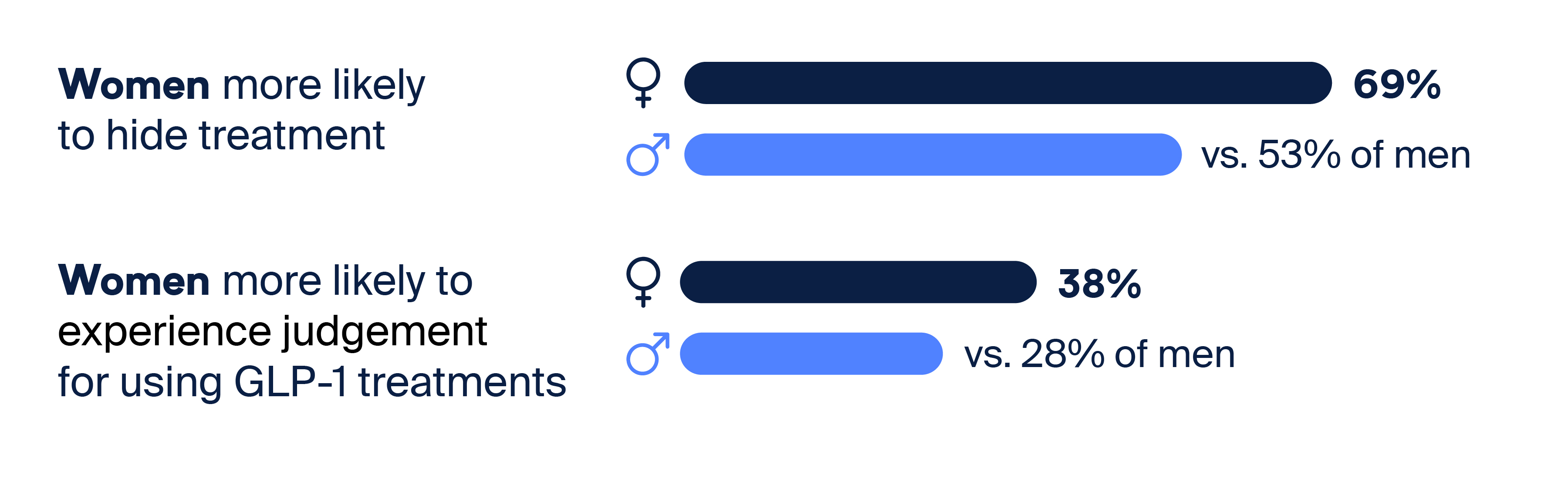
66% of patients have hidden their treatment from some or all friends and family, and more than a third (38%) say they have experienced judgement for using GLP-1 treatments. Among those who faced criticism, nearly eight in ten (79%) report being accused of taking the “easy way out”, 68% were told to “just eat less and move more” and more than three quarters (79%) have been told at least once that they’d “just put the weight back on”.
“I just haven't told anyone, not because of how I feel but the sentiments other people seem to have and share, I’ve had conversations with people at work, they say it’s the easy way out or cheating”
Existing GLP-1 patient (female, age 37)
For many, stigma is a real barrier to care. One in five patients (21%) say social stigma was one of their top concerns when considering whether to pursue treatment at all, highlighting how social attitudes can shape healthcare choices.
The data also shows that stigma is highly social and uneven. Younger adults are the most likely to hide treatment, with concealment peaking at 74% for Gen Z, compared with 60% among Boomers and 43% among Silent Generation patients. Women are also significantly more likely to conceal treatment than men (69% vs 53%), reinforcing the gendered nature of weight-related judgement. Whilst exposure to stigma or judgement via social media is even across age groups, women are around 20% more likely to face it via social platforms than men.
A generational shift in attitudes
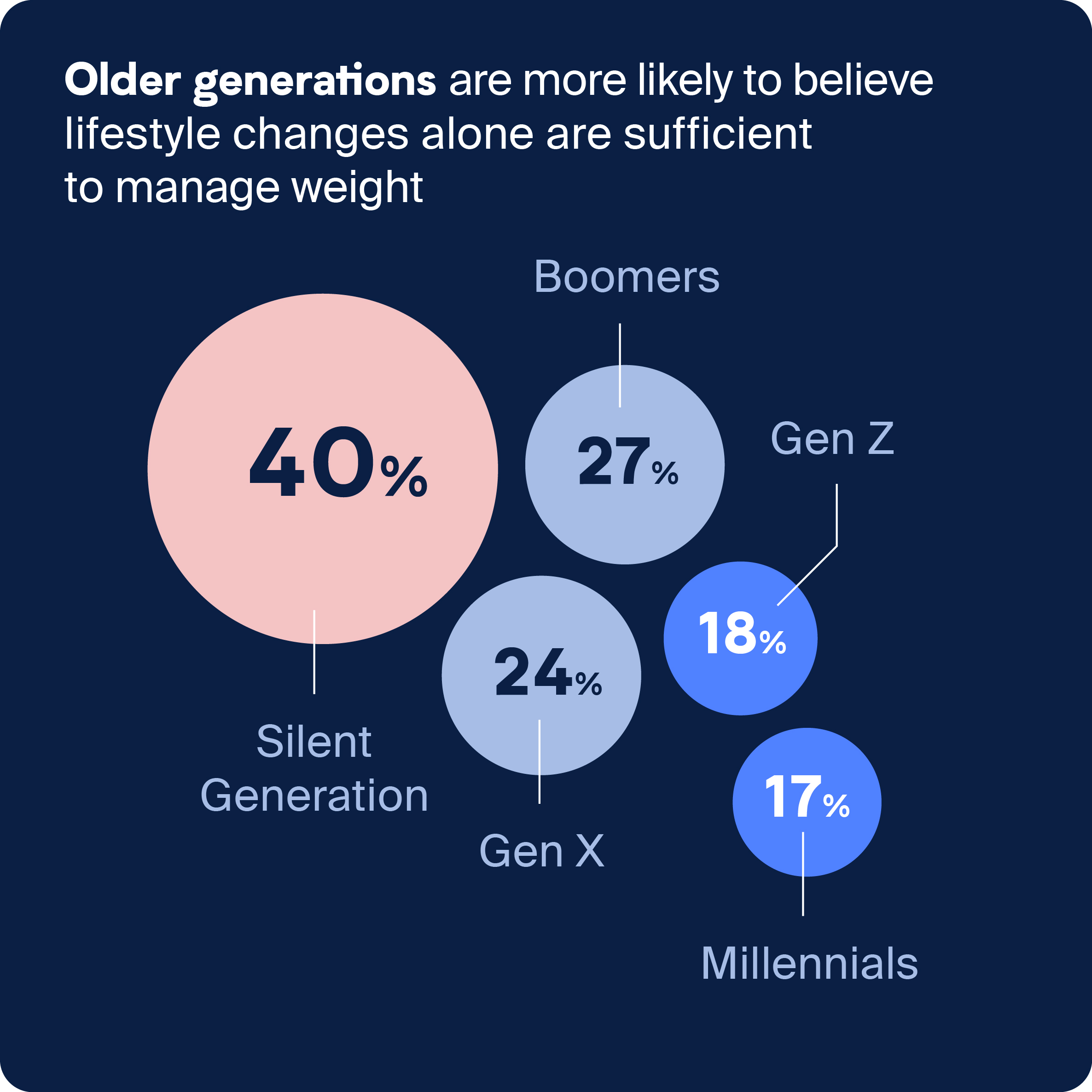
The research points to a clear generational divide. Half of Gen Z respondents say they would consider or are already using GLP-1 treatments, compared with 20% of Boomers and 10% of Silent Generation respondents. Younger adults are also more likely to recognise that obesity is a chronic medical condition, rather than simply a lifestyle choice, while older groups believe more strongly that managing weight is just simply about lifestyle.
This creates a contradiction: the groups most open to treatment, and most understanding of obesity as a chronic disease, not just a lifestyle choice, are also the most likely to hide their treatment journey from friends and family.
“Framing obesity purely as a lifestyle issue often fuels the perception that treatment is the ‘easy way out’, which can discourage people from seeking support. The language used in media, healthcare and everyday conversations matters – judgemental or triggering messaging can reinforce stigma, while supportive, respectful communication helps patients feel safe, understood and more able to engage with treatment,” said Laura Perez, Clinical Nutrition Lead at Simple Online Pharmacy.
Real lives vs public narratives
Despite public perception of GLP-1 treatment as a short-term fix, a shortcut and an “easy way out”, an overwhelming 92% of patients report improvements in their overall health, alongside gains in energy, mobility and confidence. Many also describe long-term lifestyle changes, with 88% saying treatment has helped them sustain healthier eating and activity habits rather than replace them.
This research also shows patients try an average of four different weight loss methods before starting GLP-1 medication, suggesting medical support often follows years of effort, rather than replacing it.
With 62% of consumers still saying they would never consider GLP-1 treatment, the research highlights a growing gap between perception and lived experience. While outcomes are improving, public discourse remains heavily shaped by stigma, outdated narratives about willpower, and the idea that medical weight management is “too easy.”
Effective pharmacological interventions are now well established, yet the challenge that remains is one of alignment. Bridging the gap between public perception and clinical reality will be critical to supporting appropriate uptake, sustained adherence and the more effective use of health system resources.
-ENDS-
Notes to Editors:
The full report can be found at www.simpleonlinepharmacy.co.uk/research/stigma-survey.
Imagery and data visualisations are available here, and patient case studies are available upon request.
Regional statistics – highlights:
- North East: Patients from this region report the lowest levels of judgement from friends and family, but highest at work. They also appear the most open with their treatment, with 51% admitting to hiding their treatment from friends and family (Wales being the next most open, at 61% hiding their treatment).
- East Midlands: Respondents from the East Midlands report the highest levels of judgement from friends and family (87%). London, West Midlands and Yorkshire & The Humber come in joint highest (84%).
- North West & Yorkshire & The Humber: Patients report the highest level of stigma exposure from social media at nearly 1 in 3 (31%).
- London: Respondents reported the lowest level of GLP-1 rejection (40% said they would not consider) and highest overall consideration (57%)
- East of England: Respondents reported the highest rejection of GLP-1 treatment at 70%, and the lowest net consideration at just 1 in 4 (26%)
- South West: Ranks highest for patients reporting improved sleep due to losing weight (34%)
- South East: Of all respondents, those from the South East report the longest treatment journeys, with nearly half (47%) being on GLP-1 treatment for more than nine months
- Wales: Patients in Wales cited being in control of eating habits as the second most common motivator to starting GLP-1 treatment, at more than double the rate of England and Scotland.
- Scotland: Overall, Scottish respondents report spending less on food since using GLP-1 treatment (78%), split between 44% eating less and 34% saving money by reducing takeaways and snacks
- Northern Ireland: Patients report the lowest exposure to judgement for using GLP-1 treatment, at just 23%, vs 30% in Wales, 37% in Scotland and 38% in England
About World Obesity Day
World Obesity Day, held annually on the 4th March, is a global initiative to raise awareness about obesity, reduce stigma, and promote understanding of the condition as a complex health issue.
Methodology
Patient survey n=3,086 (Simple Online Pharmacy GLP-1 users, non-nationally representative). Consumer survey by Onepoll n=2,000 (UK nationally representative). Fieldwork conducted 2025-2026.
About Simple Online Pharmacy
- Simple Online Pharmacy is a UK-based digital healthcare provider dedicated to making safe, convenient, and regulated medications accessible to patients in the UK, Australia, Germany and Denmark
- Simple Online Pharmacy has supported over 340,000 people across the UK access obesity management medication and support from its multidisciplinary team, comprising GPs, pharmacists, pharmacy technicians, nutritionists and dietitians.
- Founded in Glasgow in 2015, the company employs more than 150 people. Since 2022, the business has grown ten-fold, investing back into patient care, digital innovation, multidisciplinary care and employee engagement, and has been recognised in the FT1000 list of Europe’s fastest growing companies.
For more information, please contact Vicci.Cowlett@simpleonlinehealthcare.com or Melanie.Gray@simpleonlinehealthcare.com.
Press release distributed by Pressat on behalf of Simple Online Pharmacy, on Wednesday 4 March, 2026. For more information subscribe and follow https://pressat.co.uk/
Healthcare GLP-1 GLP-1s Weightloss Obesity Stigma Judgement Health
Published By
vicci.cowlett@simpleonlinehealthcare.com
https://www.simpleonlinepharmacy.co.uk/
Visit Newsroom

You just read:
2 in 3 patients hide weight loss treatment from friends and family, new UK study finds
News from this source: