
* For more information regarding media usage, ownership and rights please contact
FCI London.

LONDON, UK – February 10, 2026 – Analysis of recent transaction data from FCI London reveals that the living room has become the undisputed focal point of renovation expenditure for luxury homeowners. This single category now commands an estimated 38% of total consumer budgets, positioning it as the primary engine of growth and the most significant area of investment within the home.
The comprehensive breakdown, based on actual transaction data from FCI London's 2025 sales, provides unprecedented insight into how affluent homeowners allocate their interior design budgets across different room categories, revealing a clear hierarchy in renovation priorities.
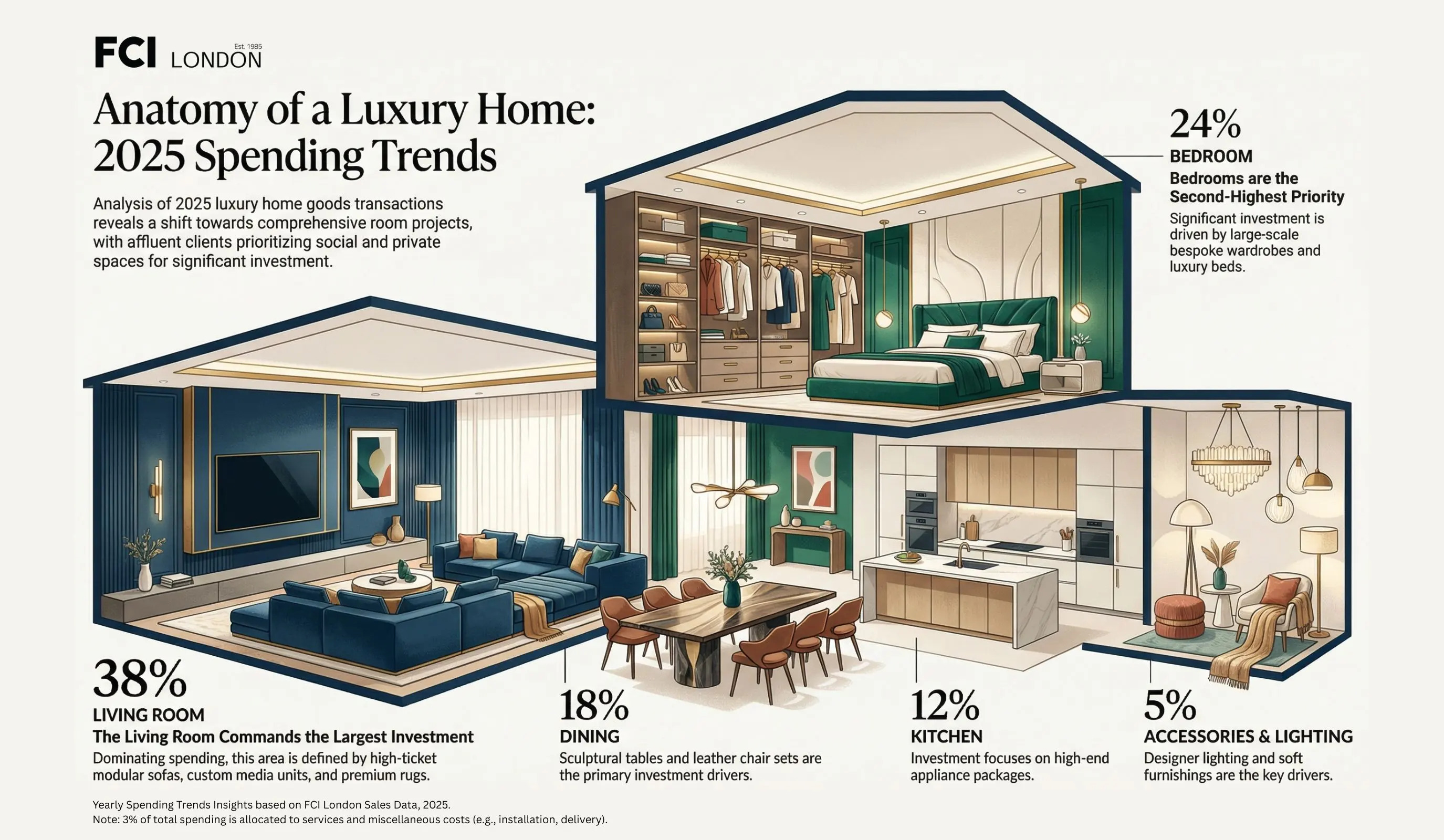
The following breakdown identifies where people spent the most, calculated as an approximate percentage of total sales based on the distribution of order values and item categories:
In the dynamic luxury home goods sector, a deep understanding of consumer spending patterns is paramount for strategic planning. Analysing where high-net-worth individuals allocate their renovation budgets allows retailers, designers, and manufacturers to anticipate market trends, refine product offerings, and align marketing efforts with shifting consumer priorities. For 2025, this analysis reveals a clear and decisive shift in focus, providing an invaluable roadmap for stakeholders across the industry.
This report's central finding is unambiguous: analysis of recent transaction data reveals that the living room has become the undisputed focal point of renovation expenditure. This single category now commands an estimated 38% of total consumer budgets, positioning it as the primary engine of growth and the most significant area of investment within the home.
This report will first provide a granular, category-by-category breakdown of consumer expenditure to quantify these priorities. Following this, it will analyse two distinct customer segments - homeowners and renters - to uncover the nuanced purchasing behaviors influenced by property tenure.
The report will conclude with the key strategic implications of these findings, offering actionable insights for capitalising on the market's direction. Examining the granular expenditure breakdown reveals not just a hierarchy of spending, but the specific product archetypes driving value in this market.
Based on the transaction data and category descriptions provided in the sources, the Living Room and Bedroom categories represent the highest areas of expenditure, driven by high-end items like luxury sofas and bespoke wardrobe joinery.
Category | % of Total Sales | Primary Drivers |
Living Room | 38% | Modular sofas, TV media walls, Rugs |
Bedroom | 24% | Bespoke wardrobes, Luxury beds |
Dining | 18% | Ceramic/Wood tables, Leather chairs |
Kitchen | 12% | High-end appliances (Gaggenau/Miele) |
Accessories | 5% | Lighting, Vases, Mirrors, Soft furnishings |
Services | 3% | Design fees, Installation, Shipping |
The Living Room commands 38% of total sales, solidifying its position as the primary theater for modern home investment. This dominance is propelled by high-ticket items that serve as the focal point of the home's design and social function. The primary financial drivers are large, expensive modular sofas, sophisticated integrated TV units, and expansive, high-quality rugs that anchor the space.
An effective analogy captures this dynamic perfectly: if a luxury home project were a theatrical production, the Living Room would be the main stage where the most expensive sets (sofas and media units) are placed for maximum impact.
This illustrates the living room's essential role as the primary venue for social expression, entertainment, and the showcasing of personal style, justifying its significant share of the overall budget.
Following the living room, the Bedroom emerges as the second-highest area of expenditure at 24% of total sales. This investment is driven by a desire for personalised sanctuaries and long-term, integrated solutions. Spending is driven by significant capital outlays for integrated solutions like bespoke wardrobes and custom headboard joinery, which are viewed as permanent additions to the property.
These are complemented by high-value luxury beds, reinforcing the bedroom's role as a space for personal comfort and lasting quality.
The Dining category, representing 18% of sales, serves as a critical hub for social gathering and formal entertainment. Its value is driven by architecturally significant centerpiece items, such as large sculptural dining tables, often crafted from premium ceramic or wood. This primary investment is amplified by the cumulative value of accompanying items, particularly large sets of high-quality leather dining chairs, which together create a cohesive and high-impact entertaining space.
While accounting for a smaller portion of the total, the Kitchen, Accessories, and Services categories play crucial supporting roles in complete luxury renovation projects.
The Luxury Kitchen category (12%) is characterised by high-value, low-volume transactions. Spending here is concentrated in technologically advanced, integrated appliances from premium brands like Gaggenau, V-Zug and Miele. These purchases represent a significant investment in a home's functionality and long-term asset value.
In contrast, the Accessories & Lighting category (5%) is the most popular category by item quantity but lower in total sales percentage. It encompasses the vital finishing touches - such as designer lighting, vases, mirrors, and soft furnishings - that complete the aesthetic and add layers of personality to a project.
Finally, the Services & Miscellaneous category (3%) covers the essential logistical and professional fees that underpin a high-end renovation. This includes interior design fees, specialised delivery and installation charges, and any necessary storage fees, ensuring the project is executed to a professional standard.
Segmenting the luxury consumer base provides critical strategic insights. While both homeowners and renters participate in the high-value home furnishings market, their property tenure fundamentally influences their purchasing psychology, investment horizons, and product choices.
An analysis of transaction data based on whether a client owns or rents their property reveals two distinct behavioral profiles.
The spending profile of customers renovating properties they own is geared towards permanence, personalisation, and property value enhancement. Investments in this segment often involve structural or semi-permanent installations that are seamlessly integrated into the home's architecture.
This focus on permanence directly explains the significant 24% budget share allocated to Bedrooms for integrated solutions like bespoke wardrobes, and the 12% to Kitchens for high-end appliances - investments that enhance long-term property asset value. These clients are investing not just in aesthetics, but in the long-term asset value of their property.
Customers furnishing high-end rental properties exhibit a different set of priorities. Their purchasing decisions are shaped by the need to make a significant stylistic impact without making permanent structural alterations.
Consequently, this segment prioritises non-permanent, high-impact furnishings that can define a space and be moved to a future residence. This strategic prioritisation of non-permanent assets directly fuels the living room's 38% market dominance, as large modular sofas and statement dining sets deliver maximum design impact without structural commitment.
This analysis confirms a clear hierarchy in the luxury renovation market, headlined by the financial dominance of the Living Room, which accounts for 38% of total expenditure.
This is followed by significant, but secondary, investment in the Bedroom (24%) and Dining room (18%). Furthermore, the data reveals nuanced behavioral differences between homeowners, who invest in permanence and property value, and renters, who prioritise high-impact, moveable assets. These findings present clear strategic opportunities for businesses operating in the luxury home goods sector.
The primary strategic implications are as follows:
Marketing & Merchandising: The clear imperative for marketing and merchandising is to reorient showroom layouts and campaigns around the "main stage" concept of the living room. This space must be presented as the home's aesthetic and social centerpiece, with modular sofas and media walls positioned as premier investment pieces.
Product Development: For product development, the mandate is unequivocal: innovate in high-value modular sofa systems and integrated media solutions to capture the market's primary revenue stream. This includes developing next-generation designs with enhanced functionality and aesthetic appeal that cater to the demand for seamless entertainment hubs.
Service Offerings: Service offerings must be strategically adapted to create curated furnishing packages tailored to the high-end rental market. These packages should focus on non-permanent, high-impact pieces for the living and dining rooms, offering a turnkey solution that balances aspirational style with the practical need for portability.
Ultimately, the FCI London sales data 2025 shows that the living room is more than just a room; it is the central forum for self-expression, social connection, and significant financial investment in the luxury home. For businesses aiming to thrive in 2026 and beyond, aligning strategy with this reality is not just an opportunity, but a necessity.
FCI was established in 1985 and has grown from a 5000 sq ft showroom to one of the largest designer furniture and lifestyle houses in the UK. We are an independently owned family business with deep roots in furniture design, manufacture and interiors.
We have one of the largest contemporary furniture showrooms in the UK, displaying the most exclusive quality pieces from the world’s most exclusive quality designers.
Book a showroom visit and experience FCI London’s stunning, multi-award-winning 30,000 sq ft showroom London’s largest luxury furniture destination, home to over 700 luxury brands under one roof. Founded in 1985 and open 7 days a week.
Distributed by Pressat