
* For more information regarding media usage, ownership and rights please contact
News Aktuell.

Kassel, 30 June 2026. The Volksbund Deutsche
Kriegsgräberfürsorge e. V. is working alongside French and British
partner organisations to commemorate those who lost their lives in the
First World War in France. Taking part in a joint tri-national youth
exchange are 24 young people from France, the United Kingdom and the
Federal Republic of Germany.
110 years ago, the First World War raged across Europe. The
‘catastrophe of the 20th century’ claimed an unprecedented number of
lives and devastated towns and countryside. The battles of the Somme
alone – in which troops from the Commonwealth and France fought against
German positions from July to November 1916 – cost the lives of over a
million soldiers. Traces of the war are still visible there today.
A scarred landscape: the Lochnagar crater
On 1 July, the day the battles began 110 years ago, delegations from
the Volksbund Deutsche Kriegsgräberfürsorge, the Commonwealth War Graves
Commission (CWGC) and the French Office National des Combattants et des
Victimes de Guerre (ONaC VG) will come together to commemorate the
event.
The commemorations begin at a historic site: the Lochnagar crater.
With a diameter of 91 metres and a depth of 21 metres, it symbolises the
newly developed technical destructive power of the First World War.
British sappers had spent months tunnelling beneath German positions and
placing vast quantities of explosives there. The blast on 1 July 1916
at 7.28 a.m. is regarded as one of the largest explosions in the history
of warfare. A ceremony takes place at this site every year at the exact
time. As a symbol of reconciliation, a human chain is formed around the
crater.
Great-grandchildren meet on the battlefields
Remembrance must not be lost, but must be carried forward into the
future. The three organisations have invited 24 young people from
France, the United Kingdom and Germany to a tri-national youth exchange
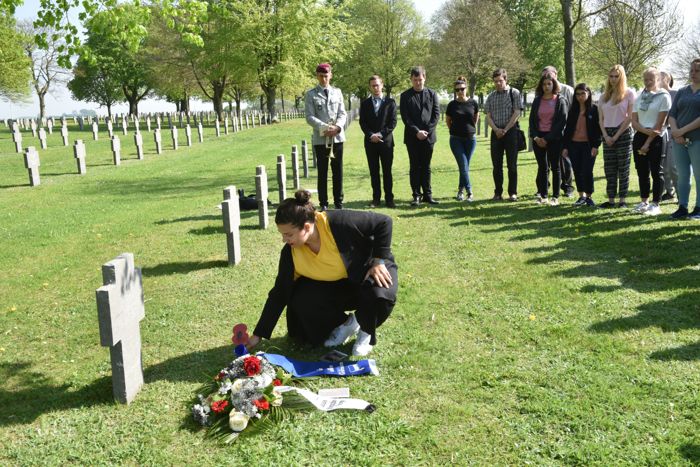
in Péronne on the Somme. Over the course of a week, the young people –
eight from each country – will explore the violent history of their home
countries during the First World War, visiting museums, war cemeteries
and memorial sites of the three nations.
Commemorating the Commonwealth’s missing at Thiepval
Together with Volksbund Secretary-General Dirk Backen, they will take
part in the commemorative service at the ‘Memorial to the Missing’ in
Thiepval on 1 July, organised by the Royal British Legion. The monument
commemorates the 72,337 missing South African and British soldiers and
is the largest Commonwealth war memorial in the world.
The central French memorial site for the Battles of the Somme is the
Chapelle du Souvenir Française in Rancourt. There, on 1 July at 10.30
a.m., the French fallen will be commemorated. The young people will lay
flowers during the ceremony.
The Volksbund delegation will take part in the memorial service at the German war cemetery in Fricourt at 5.30 p.m.
International commemoration in Maissemy
Following a silent wreath-laying ceremony in Maissemy, the Volksbund
invites you to the international commemoration at the German war
cemetery in Maissemy on 2 July at 11.00 a.m.
Speakers there will include the Mayor of Maissemy, Hubert Delalieu;
the Director-General of the ONaC VG, Marie-Christine Verdier-Jouclas;
the Deputy Chairman of the CWGC, Peter Hudson; the Volksbund
Secretary-General, Dirk Backen; and the Prefect of the Aisne department,
Fanny Anor. The young people will also contribute to the ceremony.
How do young people engage with historical issues?
They exchange views in workshops and working groups and seek answers:
Why were civilian societies able to become enthusiastic about the war
and be mobilised? What does the death of a soldier mean for families?
How do nations commemorate their dead? Why do the cultures of
remembrance in the Commonwealth, France and the Federal Republic of
Germany differ so greatly?
Poppies, cornflowers, forget-me-nots: flowers of remembrance
History continues to shape the present day. The lessons the young
people draw from it are intended to help shape a more peaceful future.
Alongside many experiences, they take home blossoming symbols of
remembrance: flower seeds. Cornflowers symbolise remembrance in France,
red poppies commemorate the victims of war in the Commonwealth
countries, and forget-me-nots honour German war dead.
Operation Levi: A Sign of Care, the Fight against Anti-Semitism
The Volksbund is currently continuing Operation Levi at German war
cemeteries in France. Background: Many German Jewish soldiers are buried
beneath a Christian cross, in some cases for various reasons. Operation
Levi rectifies this by replacing the grave cross with stelae bearing a
Star of David. At the comrades’ graves, the names of the Jewish soldiers
are adorned with a small rosette bearing the Star of David. The graves
of 21 Jewish soldiers will then be correctly marked. Through Operation
Levi, the Volksbund is sending a clear signal against both old and new
forms of anti-Semitism and demonstrating that care for military
personnel does not end with death.
Contact:
Volksbund Deutsche Kriegsgräberfürsorge e. V.
spokesperson Diane Tempel-Bornett
+49561-7009-139
[email protected]
Distributed by Pressat