
* For more information regarding media usage, ownership and rights please contact
Inside Out Justice.

As around 700 prisoners leave jails in England and Wales on the first day of earned progression, Inside Out Justice warns that a record recall rate, an overstretched Probation Service and a raft of new licence restrictions threaten to send many of them straight back.
Inside Out Justice today warned that the Government’s early release scheme will be undone by its own recall system unless ministers act now, as the first prisoners released under the Sentencing Act 2026’s earned progression model walked free and the Ministry of Justice unveiled what it calls “the toughest supervision in British history”.
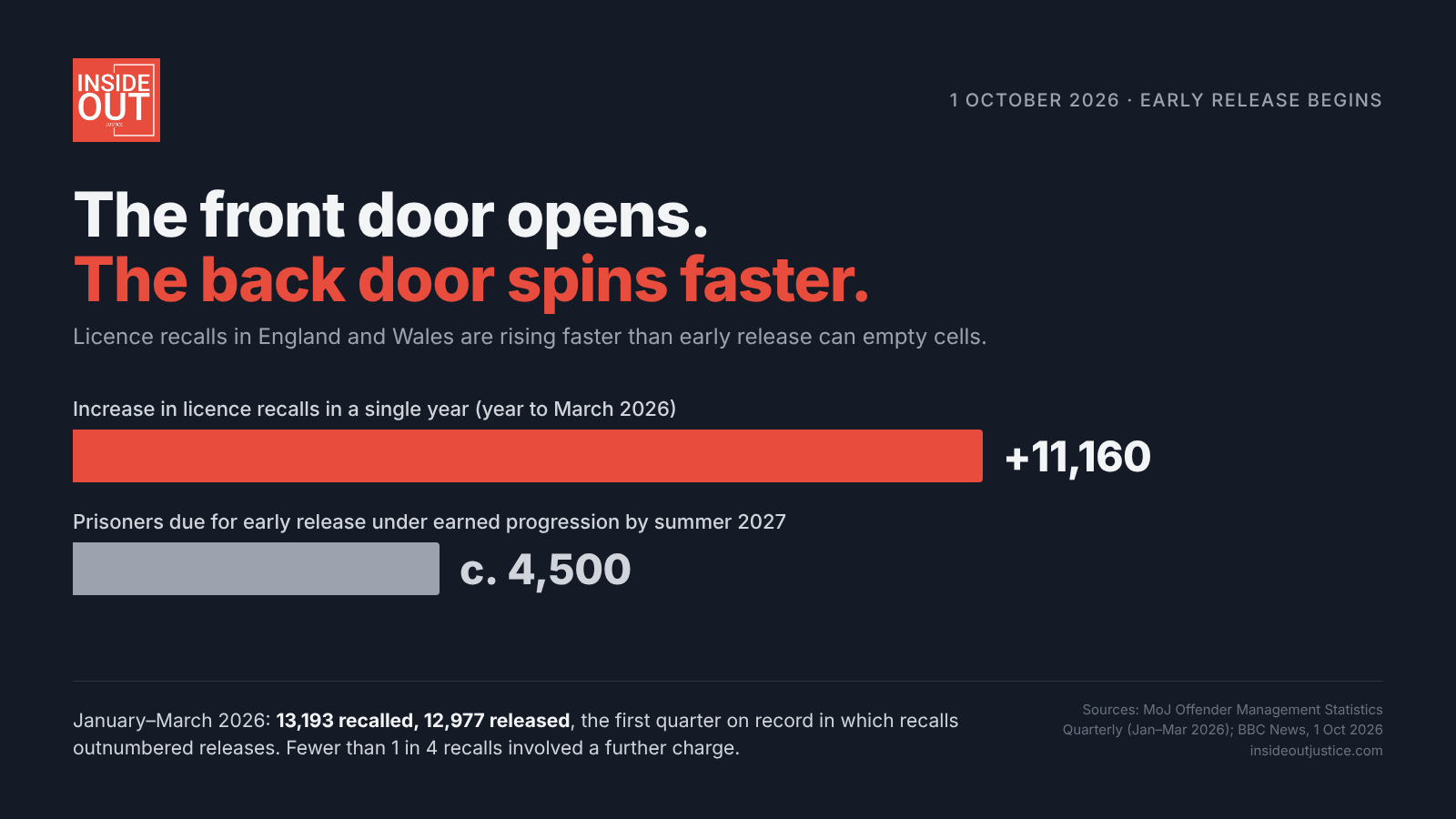
Around 700 prisoners are being released today, with about 2,550 due out by the end of the year and roughly 4,500 by next summer. Eligible prisoners now move onto licence at the one-third point of their sentence rather than halfway, so each of them will spend longer under probation supervision - and longer exposed to recall. On Friday 26 September the estate held 87,499 people with around 1,500 places to spare, and the Ministry of Justice says adult male prisons are at 98 per cent of capacity.
The recall system is already moving in the opposite direction. There were 51,419 licence recalls in the year to March 2026, up from 40,259 the year before - an increase of 11,160 in twelve months, well over double the number of people the earned progression scheme expects to release by next summer. In the first quarter of 2026, 13,193 people were recalled while 12,977 were released: the first time on record that recalls have outnumbered releases.
Most recalls are not for new crimes. Between January and March 2026, non-compliance with licence conditions was recorded in 9,683 recalls and failure to keep in touch with a probation officer in 5,025, while 2,891 involved a further charge. More than one reason can be recorded against each recall. Since 31 March 2026, most of those recalled serve a fixed 56 days in custody - long enough to lose a tenancy and a job, too short for any meaningful rehabilitation.
Today the Government has added further conditions to the licences of those leaving prison: restriction zones confining the highest-risk offenders to areas a few miles wide; bans from pubs, clubs, football matches and public events; a presumption of electronic tagging on release; and, from next year, random drug testing. Each new condition is another line that can be crossed and, on current practice, another route back to custody for a breach that involves no new offence.
The machinery needed to enforce those conditions fairly is not yet in place. A joint briefing from HM Inspectorate of Probation and HM Inspectorate of Constabulary and Fire & Rescue Services, published on 29 September, reportedly found that only 55 per cent of GPS and radio-frequency tags were fitted on time, with some people waiting up to five months. HM Chief Inspector of Probation, Martin Jones, has said he is “not fully confident” the service will cope. Probation sources told The Guardian today that approved accommodation in some areas is already full and that some people may be released “straight on to the street” - yet failure to reside at an approved address features in around a quarter of all recalls.
“Today the front door of our prisons opens a little wider, but the back door is already spinning faster. Recalls rose by more than 11,000 in a single year; this scheme will release around 4,500 people by next summer. You do not need to be an economist to see which number wins.”
“The Government is proud of the toughest licence conditions in British history. But a condition is only as good as the system that enforces it fairly. If tags are fitted months late, if hostels are full and if probation officers are carrying caseloads they cannot manage, more conditions simply mean more breaches - and more people back in a cell for 56 days for something that was never a crime.”
“Nobody disputes that people who pose a real risk to victims must be recalled swiftly. That is exactly why recall must be reserved for risk. Every cell taken by someone who missed an appointment because they had nowhere to live is a cell that is not available for the dangerous offenders ministers rightly say they want kept off the streets.”
- Scott Dylan, Founder of Inside Out Justice
Inside Out Justice is calling for: an independent review of recall decision-making, reporting before the earned progression tranches are complete; graduated community sanctions for technical licence breaches, so that recall to custody is reserved for genuine risk of harm or further offending; a clear guarantee that no one will be recalled for a breach caused by a late tag fitting or the absence of approved accommodation; publication of monthly recall figures alongside each release tranche, beginning with the second tranche on 13 October; and investment in probation caseloads and in housing on release.
Distributed by Pressat