https://pagepeek.ai/blog/introducing-pagepeek-an-ai-academic-os-for-the-modern-research-workflow
* For more information regarding media usage, ownership and rights please contact
PAGEPEEK LTD.
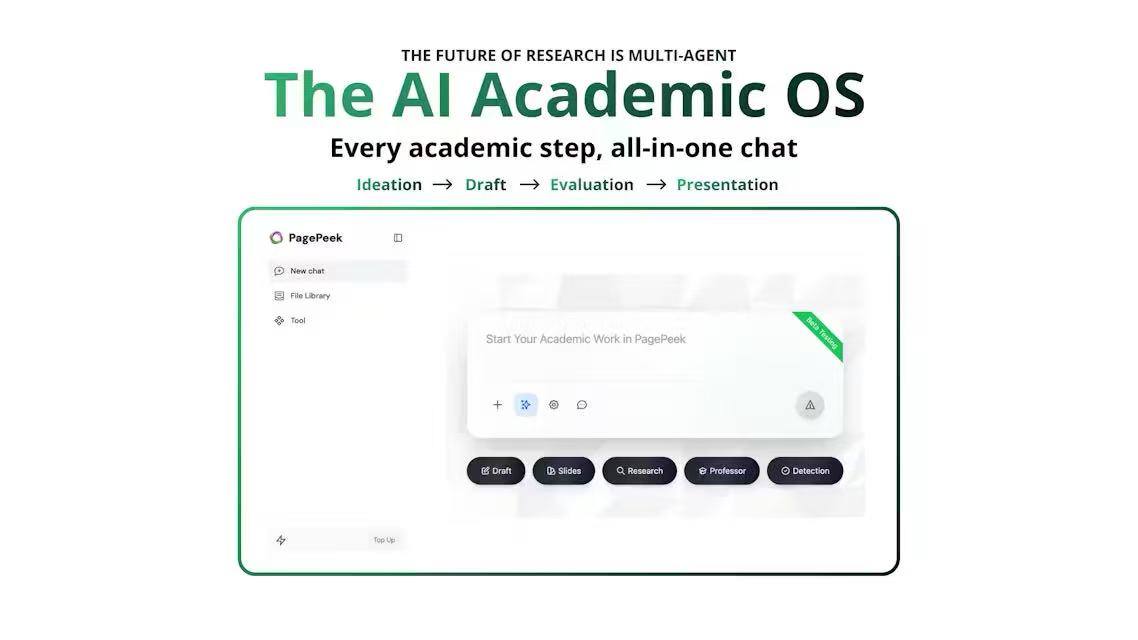
As digital tools continue to reshape higher education and research, academic work has become both more powerful and increasingly fragmented. Students and researchers now rely on multiple disconnected tools—search engines for literature review, PDFs for reading, writing software for drafting, citation managers for references, AI tools for evaluation, and slide software for presentations.
While each tool solves a specific problem, the lack of integration often leads to context loss, duplicated effort, and reduced academic productivity. This growing challenge has been described by some in the EdTech sector as “academic workflow fragmentation.”
To address this issue, PagePeek has announced the launch of PagePeek, an AI Academic Operating System (AI Academic OS) designed to unify the modern research workflow within a single, shared context.
PagePeek is built to integrate the core stages of academic work—drafting, research, evaluation, detection, and presentation—into one cohesive environment. Instead of switching between multiple platforms, users can move from idea to final output without losing structure, citations, or analytical intent.
The platform supports tasks such as structured academic drafting, citation-based research, iterative evaluation, and presentation generation, all within a single workspace. This approach reflects a broader shift in academic productivity tools toward system-level integration rather than standalone features.
Most academic tools are designed as isolated solutions, optimized for a single step in the research process. However, academic work functions as a continuous system rather than a linear checklist.
PagePeek was developed around the idea that academic productivity improves when tools share context instead of requiring users to repeatedly re-enter information across platforms. By maintaining continuity throughout the research workflow, integrated systems can reduce cognitive load, minimize tool switching, and support academic rigor without sacrificing speed.
At the core of PagePeek is a multi-agent AI architecture, with specialized agents designed for tasks such as drafting, research, evaluation, and presentation. These agents operate within a shared context, allowing arguments, citations, and structure to remain consistent across all stages of academic work.
This design reflects an emerging trend in AI-assisted research workflows, where collaboration between specialized AI components replaces isolated, task-specific tools.
PagePeek is scheduled to launch publicly on Product Hunt on January 26. To mark the release, newly registered users will receive 120 free credits, valid for 15 days after sign-up, providing access to the full academic workflow experience.
PagePeek is intended for a broad academic audience, including:
University students working on essays and research papers
Graduate students and PhD candidates managing complex research projects
Researchers and academics seeking structured, citation-aware workflows
Users looking to improve academic productivity through integrated tools
As academic research becomes increasingly digital and interdisciplinary, platforms that reduce fragmentation and preserve context are expected to play a growing role in modern education and research environments.
Distributed by Pressat