* For more information regarding media usage, ownership and rights please contact
PAGEPEEK LTD.

If you’re searching for “grade my essay”, you’re likely asking one core question:
If my lecturer graded this today, where would I lose marks — and why?
Most students don’t lose marks because they lack ideas. They lose marks because arguments are unclear, structure doesn’t follow the brief, or academic standards aren’t met consistently.
This guide explains how to grade your own essay step by step, using academic proofreading principles, rubric-based evaluation, and ethical AI support. The goal is not just a higher grade — but clearer thinking and stronger academic writing.
In academic terms, grading an essay means evaluating it against explicit criteria, not personal preference.
When markers grade essays, they typically assess:
So when students ask “Can I grade my essay before submitting it?”, what they really want is pre-submission academic evaluation — the ability to see their work through a marker’s lens.
Before checking grammar or citations, step back and read your essay as a whole.
This is the most overlooked step in academic proofreading — and often the most important.
How to do a holistic review
Questions academic markers implicitly ask
What to fix at this stage
Only after this step does detailed academic proofreading become effective.
Once structure is solid, you can begin grading your essay more precisely.
1. Use the marking rubric as your grading framework
Every academic assignment is graded against a rubric — explicitly or implicitly.
To grade your essay accurately:
This mirrors how academic markers allocate marks.
2. Use peer review to expose blind spots
Peer review is not about agreement — it’s about perspective.
Ask classmates for:
If multiple reviewers flag the same issue, that issue likely affects your grade.
3. Apply AI-assisted academic proofreading responsibly
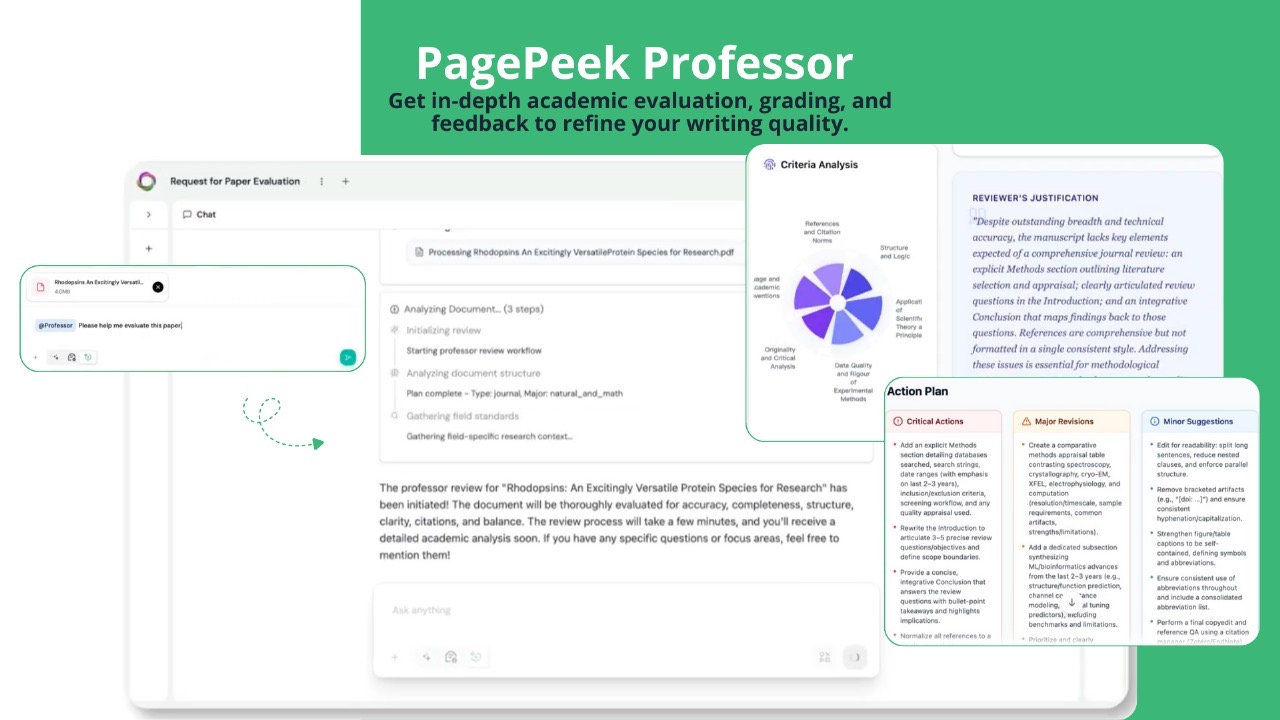
AI tools like PagePeek can support academic proofreading by identifying:
Used ethically, AI does not replace your thinking. It helps you see where your writing fails to communicate your ideas clearly.
In some cases, selective rewriting can help. Knowing when to rewrite your essay — and when not to — is part of academic skill development. Always follow your institution’s academic integrity guidelines.
AI Professor——The final stage protects marks already earned.
Before submitting, check:
Academic proofreading tools can help catch inconsistencies, but final responsibility always lies with the student.
A brief reflection — What is one strength of this essay? What would I improve next time? — strengthens long-term writing ability.
Grading your own essay is not about guessing a mark. It is about understanding how academic quality is judged.
A reliable process — holistic review, rubric-based evaluation, peer feedback, and responsible AI-supported academic proofreading — allows you to identify weaknesses before they affect your grade.
If you often think “I wish I could grade my essay before submitting it”, this method gives you a practical, ethical way to do exactly that — while improving your academic writing over time.
Can AI accurately grade my essay?
AI can approximate academic evaluation by analysing structure, clarity, and rubric alignment. It should be used as guidance, not a final authority.
Is academic proofreading the same as rewriting my essay?
No. Academic proofreading improves clarity and correctness. Rewriting should be selective and focused on learning, not replacing original work.
Is it allowed to use AI to rewrite my essay?
Policies vary by institution. Many allow AI for editing and learning support if properly disclosed. Always check your university guidelines.
Distributed by Pressat