* For more information regarding media usage, ownership and rights please contact
KTR Project.
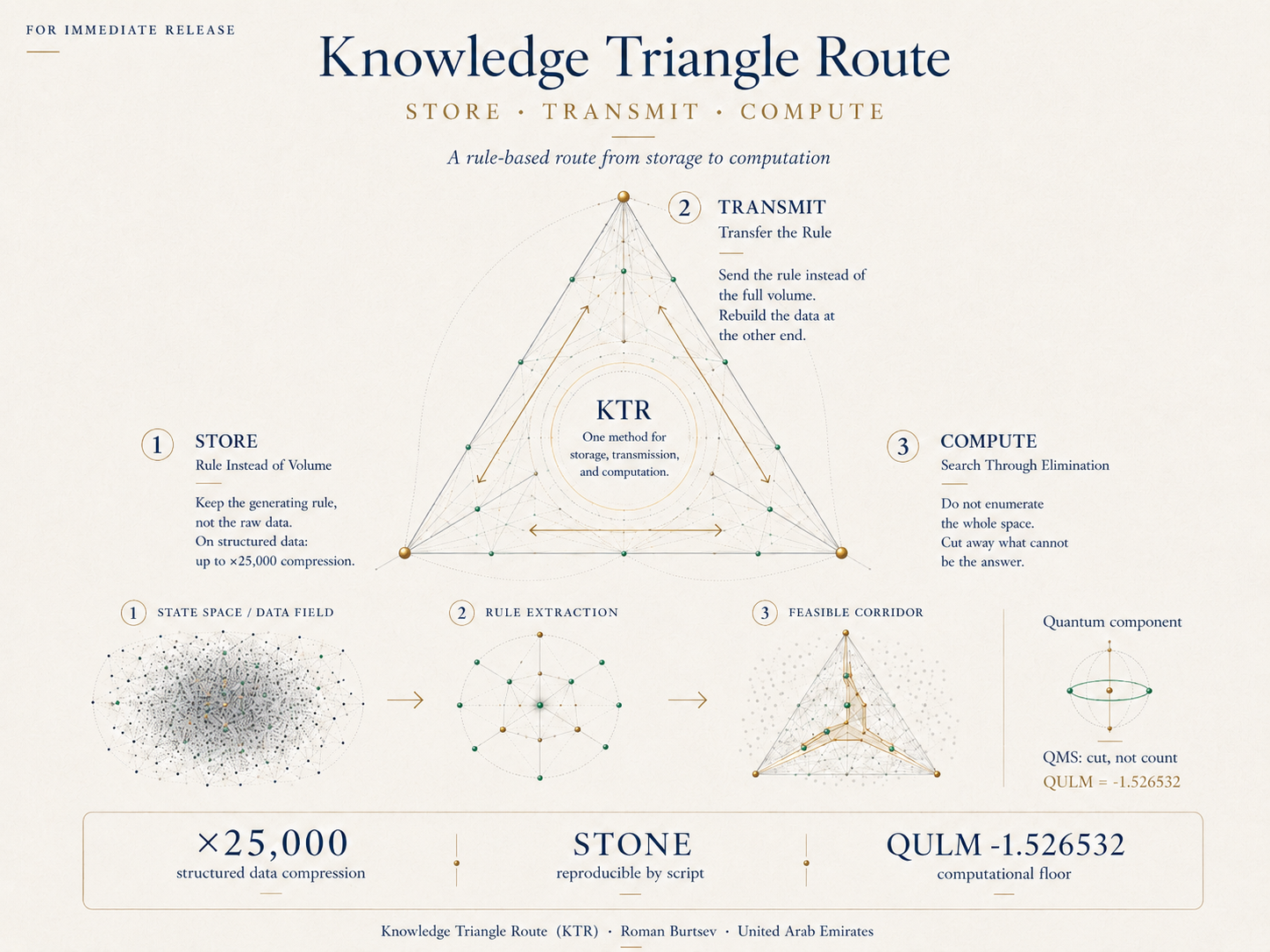
DUBAI, UAE, June 2026 — An independent research framework developed in the United Arab Emirates approaches one of the largest problems of the digital age — the relentless growth of data — from an unusual direction. Instead of storing information as raw volume, the Knowledge Triangle Route (KTR) stores the rule that generates it.
Developed by independent inventor Roman Burtsev, KTR rests on a simple idea that is easy to picture: most data is not random. A long, ordered sequence can be replaced by the short rule that produces it — and the rule is tiny compared with the data. Keep the rule, regenerate the data on demand. On structured data, this rule-based approach compresses information by up to 25,000-fold, while allowing the system to search enormous spaces and perform computations without the usual brute force. The framework delivers three unprecedented capabilities from one mechanism:
KTR began as a method of quantum-style computation, and that remains one face of it. Its computational engine, the Qutrit Map Solution (QMS), uses a "Cut, Not Count" principle to bypass the "quantum memory wall" that currently limits classical machines trying to enumerate growing spaces.
Within this work, the framework also identified a precise mathematical limit called Quantum Last Meaning (QULM). This discovery establishes a definitive computational "floor" that converges to the exact value of -1.526532, marking the threshold where infinite subdivision stops. As the research notes, this limit reveals "zero not as emptiness, but as a new structure of fullness, allowing computations to continue within this new paradigm." Quantum computation, once the sole focus of the project, is now understood as one side of a larger technological triangle alongside compression and transmission.
Unlike purely theoretical propositions, KTR is built on strict reproducibility. Results categorized as a "STONE" are mathematically proven findings accompanied by a reproducible computational script. The framework has been deposited publicly with a permanent identifier on the Open Science Framework (osf.io/kjpvg), allowing any external scientific council to verify the claims independently in minutes. This is the project's core stance: a method should be verifiable, not merely announced.
Global data volumes are growing faster than the systems that hold them, and the cost of storing, moving, and searching that data is now measured in tens of billions of dollars a year. A method that keeps the rule instead of the volume speaks directly to that pressure, offering immediate leverage for industries ranging from data centres and artificial intelligence to telecommunications and scientific computing. The principle is the same whether the data sits in a server farm or aboard a spacecraft.
This release is the first in a broader disclosure from the Knowledge Triangle Route project. Subsequent releases will detail how the same architecture extends from computing to the physical and biological sciences.
Created in the United Arab Emirates by sole inventor Roman Burtsev, KTR is a universal methodological framework designed to translate complex phenomena into computable quantities. Using three-state logic and structured algorithmic reduction, it aims to give the scientific and engineering communities verifiable tools for storage, transmission, and computation.
Distributed by Pressat